
Caregiver Jobs in Japan for Indians: Salary, Visa, Qualifications & Daily Life
A career guide built from Japan's official Immigration Services Agency and Ministry of Health, Labour and Welfare sources
Japan needs more caregivers, and it now allows foreign workers to fill these roles. Caregiver jobs in Japan for Indians are open mainly through a work permit called the Specified Skilled Worker (SSW) status, in the nursing care field. To qualify, you generally need to pass Japanese-language and nursing-care-specific tests. You do not need a Japanese caregiving qualification to apply.
This guide explains who can apply, what you can earn, which exams you need, how the process works, and what daily life is like as a caregiver in Japan.
Quick Answer
Can Indians get caregiver jobs in Japan?
Yes. Indians can work in Japan's nursing care sector through the Specified Skilled Worker (SSW) pathway. Candidates generally need to pass Japanese-language and caregiving-related examinations, secure a job with an eligible Japanese employer, and complete the required immigration process.
Can Indians Work as Caregivers in Japan?
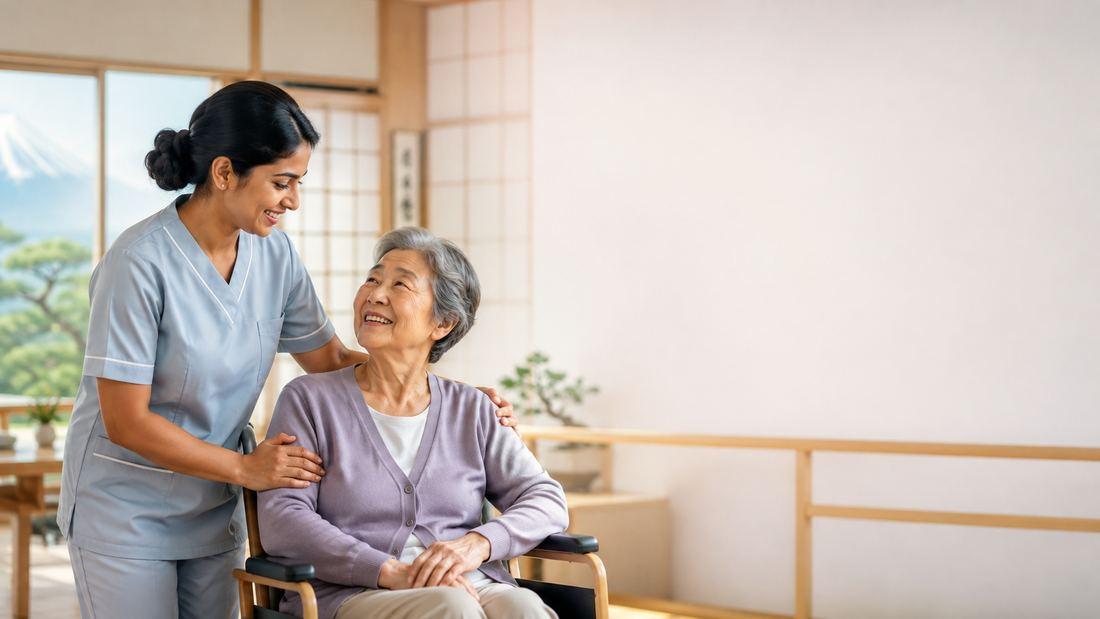
Yes. Indian nationals can work as caregivers in Japan through the Specified Skilled Worker (SSW) Nursing Care field. Japan's Immigration Services Agency created this status of residence to fill the country's caregiver shortage as its population ages.
The Agency has set an acceptance ceiling of up to 135,000 workers for this field between April 2024 and March 2029. Candidates who pass the required skills and language tests can join a registered Japanese care facility and work under SSW status for up to five years.
A second, more advanced pathway exists for foreign nationals who earn Japan's national Certified Care Worker (Kaigo Fukushishi) qualification, leading to the "Nursing Care" (介護) status of residence. Here is how the two compare:
- SSW Nursing Care: Entry-level Japanese (JFT-Basic / JLPT N4), shorter preparation timeline, capped at 5 years, no family accompaniment.
- "Nursing Care" (Kaigo) status: Higher starting Japanese (usually JLPT N2 to enter a training school), longer preparation, no fixed cap on renewals, family members can join on a Dependent status.
Most Indian candidates start with the SSW route because it is faster to prepare for. Some later move to the "Nursing Care" status once they gain experience and qualifications in Japan.
What Qualifications and Certifications Do I Need?
To qualify for the SSW Nursing Care status of residence, you need to pass three exams set by the Immigration Services Agency of Japan: the Nursing Care Skills Evaluation Test, a Japanese-language test (JFT-Basic or JLPT N4 or higher), and the Nursing Care Japanese Language Evaluation Test.
You do not need a prior Japanese caregiving certification to sit these exams.
There is a difference between the government's legal requirements and what individual employers additionally prefer:
- Government (SSW) requirements: Pass the Nursing Care Skills Evaluation Test, meet JFT-Basic or JLPT N4, and pass the Nursing Care Japanese Language Evaluation Test.
- Exemption: Candidates who have satisfactorily completed Technical Intern Training (ii) in a nursing-care-related job category may be exempt from the skills test; those who completed Technical Intern Training in nursing care specifically may also be exempt from the language tests, per the Agency's official guidance.
- Employer preferences: Individual facilities may prefer candidates with prior caregiving experience, a healthcare or nursing background, or stronger conversational Japanese, even though these are not always legal requirements under SSW.
Do not assume a specific Indian degree or diploma is mandatory for the SSW route unless an employer states it as a condition of their job offer — the government framework itself does not mandate a particular academic qualification for this category.
If you're coming from a nursing background specifically, NAVIS HR's Nursing Jobs in Japan for Indian Nurses article covers how that experience maps onto caregiving and nursing pathways in Japan.
What Japanese Language Level Is Required?
Caregiver roles in Japan need strong Japanese skills. You will talk with elderly residents every day and coordinate closely with Japanese care staff, so most candidates study Japanese for months before sitting the required exams.
For SSW Nursing Care, the Immigration Services Agency of Japan requires JFT-Basic or JLPT N4 or higher, plus the Nursing Care Japanese Language Evaluation Test. This second test checks vocabulary and communication specific to care settings.
JFT-Basic (the Japan Foundation Test for Basic Japanese) and the Japanese-Language Proficiency Test (JLPT) are two separate exams. You only need to pass one, not both.
The Nursing Care Japanese Language Evaluation Test is different — it is a sector-specific test that other SSW fields do not require. Many employers prefer candidates who keep learning Japanese beyond the minimum level, since day-to-day care work depends on clear communication with residents and colleagues.
Visa and Status-of-Residence Requirements
Two separate things are involved here, and it helps to keep them apart. A visa is the entry permission stamped by a Japanese embassy or consulate in India. A status of residence is the legal category that lets you live and work in Japan long-term, issued by Japan's Immigration Services Agency.
Caregivers on this pathway get the Specified Skilled Worker (SSW) Nursing Care status of residence. To get there:
- Pass the required exams and secure a job offer from an SSW-registered care facility in Japan.
- Your employer applies for a Certificate of Eligibility (COE) with Japan's Regional Immigration Services Bureau — the local immigration office that handles this paperwork.
- Once the COE is issued, you use it to apply for the matching visa at a Japanese embassy or consulate in India.
- You enter Japan and complete the residence procedures.
| Item | Detail |
|---|---|
| Status of residence | Specified Skilled Worker (i), Nursing Care field |
| Maximum stay | Up to 5 years total (nursing care is Type 1 only; no SSW Type 2 route exists for this field) |
| Family accompaniment | Not permitted under SSW Type 1 |
| Sponsor | A Japanese employer registered to accept SSW workers |
| Key document | Certificate of Eligibility (COE), issued via Japan's Regional Immigration Services Bureau |
This is a simplified overview, not a complete immigration manual — exact document requirements can change, so candidates should confirm current details directly on the Immigration Services Agency's Specified Skilled Worker support site or with an authorised recruitment partner before applying.
How Much Does a Caregiver Earn Per Month?
Japan's Ministry of Health, Labour and Welfare publishes two relevant wage surveys:
- Basic Survey on Wage Structure, FY2024: average monthly base wage — before overtime and bonuses
- Survey on care worker treatment, September 2024: care workers at facilities receiving a government subsidy meant to raise care-worker pay earned an average of ¥338,200 per month in total compensation — base pay plus allowances and bonuses combined. This covers care workers broadly, both Japanese and foreign, SSW and non-SSW.
Neither figure is a guaranteed starting salary for an Indian SSW caregiver. Your actual salary will be stated in the employment offer from the Japanese care facility. Treat both figures above as industry benchmarks, not a promise — your real pay depends on your employer and region.
Several factors affect what a specific candidate is actually offered:
- Employer and facility type (elderly care home, day service centre, hospital-linked facility, etc.)
- Prefecture/region — cost of living and prefectural minimum wage vary, and Tokyo and other major cities generally pay more than rural areas
- Experience and Japanese proficiency
- Shift pattern — night shifts often carry additional allowances
- Overtime and bonuses, where applicable
No single figure should be treated as a guaranteed salary. Always verify the exact monthly wage, allowances, and deductions stated in your individual employment contract before accepting a position.
What Does a Caregiver Do in Japan?
Caregivers working under SSW Nursing Care in Japan mainly support elderly residents with daily living activities in facilities such as care homes and day service centres. Typical duties include:
- Assisting residents with bathing, dressing, and grooming
- Helping with meals and feeding assistance where needed
- Supporting mobility and transfers (e.g., wheelchair to bed)
- Assisting with toileting and personal hygiene
- Supporting recreational and light rehabilitation activities
- Recording basic care notes and communicating with Japanese care staff
Before April 2025, facility-based roles were the only option under SSW.
Since April 21, 2025, SSW caregivers can also work in home-visit care services if they meet certain conditions. This generally means at least one year of facility-based experience plus required training, per the Ministry of Health, Labour and Welfare's guidance on foreign care workers in home-visit services.
What Is Daily Life Like for a Foreign Caregiver?
Daily life for a foreign caregiver in Japan generally follows a structured shift schedule at the care facility, with accommodation often arranged or subsidised by the employer near the workplace. Outside working hours, most caregivers manage daily errands, cooking, and community life using basic-to-intermediate Japanese, alongside colleagues and residents.
- Work shifts: Care facilities typically run rotating shifts, including some night duty with allowances.
- Communication: You will speak Japanese with native speakers all day, both at work and in daily life. That is why the language tests matter for more than meeting the minimum status-of-residence requirement.
- Accommodation: Many employers help arrange staff housing or dormitory-style accommodation, especially for new arrivals.
- Transportation: Most areas rely on trains, buses, or bicycles; some rural postings may require different commuting arrangements.
- Food and daily needs: Indian dietary preferences can require some adjustment, though vegetarian and familiar ingredients are increasingly available in larger Japanese cities.
- Workplace culture: Japanese care settings emphasise punctuality, teamwork, and careful documentation — adapting to these norms early makes the transition smoother.
How Can an Indian Apply for a Caregiver Job?
The general process for an Indian candidate pursuing an SSW Nursing Care job in Japan follows this sequence, though the exact order and timeline can vary by candidate and recruitment partner:
- Eligibility check — confirm you meet the age, health, and general eligibility criteria for SSW.
- Japanese language preparation — study toward JFT-Basic or JLPT N4.
- Required examinations — pass the Nursing Care Skills Evaluation Test and the Nursing Care Japanese Language Evaluation Test.
- Employer selection — match with a Japan-based care facility registered to hire SSW workers.
- Employment offer — receive and review a written job offer and contract terms.
- Status-of-residence and visa process — employer applies for your Certificate of Eligibility (COE) with Japan's Regional Immigration Services Bureau; once issued, you apply for the matching visa at a Japanese embassy or consulate in India.
- Pre-departure preparation — orientation, documentation, and practical readiness for life in Japan.
- Travel to Japan — arrival, residence card registration, and starting work.
Explore current openings on NAVIS HR's Nursing Care Careers in Japan page.
Frequently Asked Questions
Start Your Caregiver Journey to Japan
Caregiver jobs in Japan for Indians are accessible mainly through the SSW Nursing Care status of residence, which requires passing a skills test and Japanese-language tests rather than holding a prior Japanese qualification. NAVIS HR supports eligible candidates through language training, exam preparation, employer matching, documentation, and visa procedures — reach out to find out if you qualify.
Srinidhi V
SEO Lead at NAVIS HR
— Written from my desk at NAVIS HR