
Driver Jobs in Japan for Indians
Salary, Requirements & How to Apply in 2026
A driver guide built from Japan's official Specified Skilled Worker, Job Tag and National Police Agency sources
Reviewed for accuracy by the NAVIS HR Japan Placement & SSW Operations Team
AT A GLANCE
- Work route
- SSW (i) Automobile transportation
- Expected sector intake
- 24,500 April 2024 – March 2029
- Maximum stay
- 5 years Total under SSW (i)
Experienced Indian commercial drivers looking for driver jobs in Japan now have a structured pathway through Japan's Specified Skilled Worker (SSW) automobile transportation field. Under this system, foreign workers can work as truck, bus or taxi drivers for eligible Japanese transport companies.
To work legally as a professional driver in Japan, you must meet the required Japanese language level, pass the correct SSW skill test, obtain the Japanese driving licence needed for the role, secure an employer, and complete immigration procedures. This guide explains the main path in simple English. If you want the wider picture of how the SSW visa works before diving into the driver-specific route, see our guide to the Japan SSW visa.
QUICK ANSWER
Can Indians work as drivers in Japan?
Yes. Indian drivers can work in Japan under the Specified Skilled Worker (i) automobile transportation field if they meet the official skill, language, Japanese driving licence and employment requirements. Japan currently includes three commercial driving categories under this field: truck, bus and taxi driving.
Driver Jobs in Japan: Quick Overview
| Requirement | Truck driver | Bus driver | Taxi driver |
|---|---|---|---|
| SSW skill test | Truck test | Bus test | Taxi test |
| Japanese level | JFT-Basic or JLPT N4+ | JLPT N3+ | JLPT N3+ |
| Japanese licence | Class 1 | Class 2 | Class 2 |
| New-driver training | Not listed as required | Required | Required |
These are the main official SSW requirements. Individual employers may have additional recruitment conditions.
Are There Truck Driver Jobs in Japan for Indians?
Yes. Truck driver jobs in Japan are open to Indians through the SSW automobile transportation field. Indian HMV drivers must pass the SSW truck skill test, reach JFT-Basic or JLPT N4, obtain a Japanese Class 1 licence and be hired by an eligible Japanese transport company.
Of the three categories, trucking is the closest match for most Indian commercial drivers. The language bar is lower than for bus and taxi work, new-driver training is not listed as a requirement, and the vehicle handling is the nearest to HMV experience in India.
Why Are Driver Jobs in Japan Opening to Foreigners?
Japan added automobile transportation to the SSW system because the transport industry has difficulty finding enough workers.
Expected maximum acceptance of foreign workers in automobile transportation during the five-year period from April 2024 to March 2029, shown on the official SSW website.
For Indian drivers, this change is important. Commercial driving now has a structured SSW pathway, and your driving experience in India can become the starting point for a professional driving career in Japan.
What Types of Driver Jobs Are Available in Japan?
Truck Driver Jobs in Japan
Truck drivers transport goods between warehouses, factories, shops and other locations. Depending on the job, work may also include duties linked to loading, unloading and vehicle operation. For many Indian HMV drivers, truck driver jobs in Japan are the most relevant option because they build on existing commercial driving experience.
Bus Driver Jobs in Japan
Bus drivers transport passengers. Because drivers need to communicate with passengers and handle passenger-related duties, the Japanese language requirement is higher. SSW bus drivers need JLPT N3 or higher, the required Japanese Class 2 driving licence and new-driver training.
Taxi Driver Jobs in Japan
Taxi driving is also included under the SSW automobile transportation field. Taxi drivers need JLPT N3 or higher, a Japanese Class 2 licence and new-driver training.
What Are the Requirements for Driver Jobs in Japan for Indians?
There are two different types of requirements that candidates should understand.
- 1
Japanese government requirements
These are the official conditions connected with the SSW route. For truck drivers they include the SSW automobile transportation skill test for trucks, JFT-Basic or JLPT N4 or higher, the required Japanese Class 1 driving licence, and eligible employment in Japan. Bus and taxi candidates need their own SSW skill test, JLPT N3 or higher, a Japanese Class 2 licence and new-driver training.
- 2
Employer or recruitment requirements
A Japanese employer or recruitment programme may also ask for an Indian HMV or commercial driving licence, previous driving experience, experience with a particular vehicle, a specific age range, or education and other selection conditions.
Say it simply: these are recruitment conditions, not automatically Japanese government rules. Always check which requirement comes from the Japanese government and which comes from the employer.
Do Indian Drivers Need a Japanese Driving Licence?
Yes. An Indian driving licence alone is not enough for SSW commercial driving work in Japan.
Truck drivers need the required Japanese Class 1 licence. Bus and taxi drivers need a Japanese Class 2 licence.
You May Complete the Japanese Licence Process After Entering Japan
Here is something many driver-job articles do not explain clearly. Japan has a special Designated Activities preparation status for eligible SSW automobile-transport candidates. This allows candidates to complete activities needed before starting SSW driving work, including obtaining the Japanese driving licence.
- Truck candidates: the preparation period can be up to six months.
- Bus and taxi candidates: up to one year, because their route also includes Class 2 licensing and new-driver training.
Japan's National Police Agency also says that when applying to convert a foreign licence, applicants generally need to prove that they stayed in the country that issued that licence for at least three months after obtaining it. Knowledge and driving-skill checks may also apply.
How Much Can a Truck Driver Earn in Japan?
There is no single fixed salary for every truck driver in Japan.
National job-offer wage per month for truck drivers in fiscal year 2025, published on the truck driver occupation page of Japan's official Job Tag site (Ministry of Health, Labour and Welfare). The same page shows an average annual wage of about ¥5.07 million for the wider truck-driver occupation, drawn from the national Basic Survey on Wage Structure.
Your actual salary can depend on your employer, location in Japan, vehicle type, driving route, working hours, overtime, allowances and experience. Your take-home salary will also be different from your gross salary, because applicable tax, social insurance and other deductions may be taken from your pay.
Under SSW (i), foreign workers must receive remuneration equal to or higher than Japanese workers doing comparable work.
Say it simply: when comparing driver jobs in Japan, check the written employer offer rather than depending only on an advertised salary.
How Much Japanese Do Drivers Need?
Japanese language ability is compulsory for the SSW driver route.
Truck drivers need JFT-Basic or JLPT N4 or higher. Bus and taxi drivers need JLPT N3 or higher.
For drivers, Japanese is not only needed to pass an exam. You may need it to understand safety instructions, company rules, road information, daily reports and communication at work. Learning practical Japanese can therefore be just as important as preparing for the test.
How to Apply for Driver Jobs in Japan From India
The exact process can differ between employers, but the journey normally includes these stages:
- 1
Check your driver profile
Check your Indian driving licence, commercial driving experience and the recruitment requirements for the role.
- 2
Attend screening
A recruiter or Japanese employer may check your driving experience and suitability for the job.
- 3
Learn Japanese
Truck candidates prepare for JFT-Basic or JLPT N4 or higher. Bus and taxi candidates need JLPT N3 or higher. NAVIS HR's Japanese language training programme is built around these levels.
- 4
Pass the SSW driver skill test
Take the skill test for the job you want: truck, bus or taxi.
- 5
Get selected by a Japanese employer
Before accepting the offer, understand the salary, location, working hours, overtime, deductions and accommodation conditions.
- 6
Complete immigration procedures
Prepare the documents required for your Japan entry and residence status.
- 7
Obtain the required Japanese driving licence
Eligible candidates may complete the licence process during the permitted preparation period in Japan.
- 8
Start your driver job in Japan
After meeting the required licence and residence-status conditions, you can begin professional driving work.
What Makes the India-to-Japan Driver Route Different?
The biggest point to understand is this: you are not simply transferring your Indian HMV licence to a Japanese job. Your Indian driving experience is your foundation. You then add Japanese language, SSW skills, Japanese road rules and a Japanese driving licence.
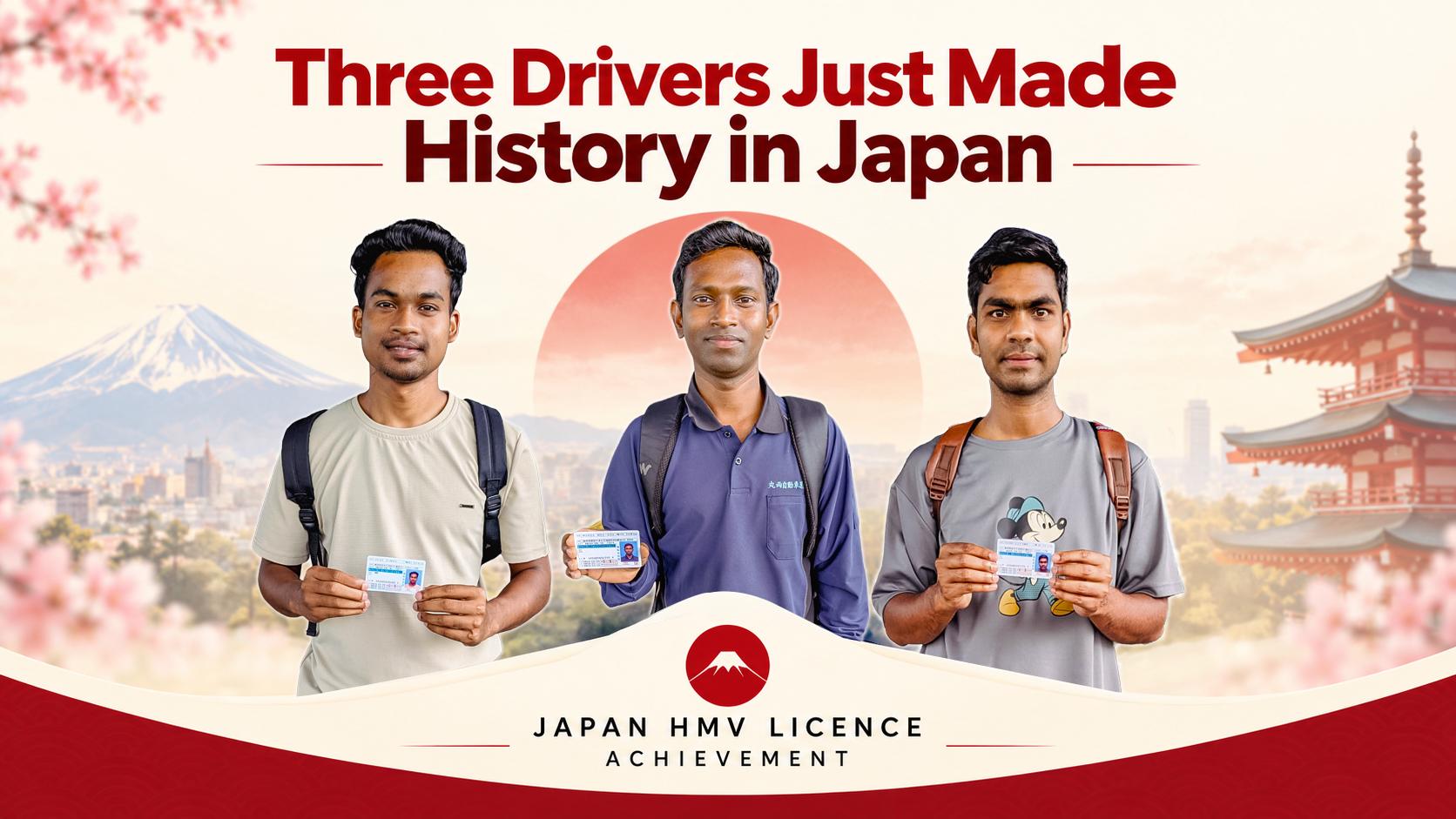
NAVIS HR Driver Milestone
Munda Masidas
Age 24 · Maruryo Transport
Xess Suman
Age 27 · Shizuoka Kami Unyu
Paikaray Dillip Kumar
Age 29 · Shizuoka Kami Unyu
In August 2026, all three passed together. These NAVIS HR candidates — aged 24, 27 and 29 — obtained Japanese large-vehicle licences at the Shizuoka Driver's Licence Centre, after previously passing the SSW truck evaluation exam in India. They progressed from HMV driving backgrounds in India to licensed driving work with Japanese transport companies.
- Starting point
- HMV commercial driving experience in India
- First milestone
- SSW truck evaluation exam passed in India
- Second milestone
- Japanese large-vehicle licence, Shizuoka Driver's Licence Centre
- Outcome
- Driving work with Maruryo Transport and Shizuoka Kami Unyu
This matters because it shows that getting a driver job in Japan is not only about finding a vacancy. Language learning, examinations, Japanese road rules and licensing are all part of the journey.
How Long the Process Takes
There is no fixed timeline for every candidate. The total process can depend on Japanese language preparation, examination dates, employer selection, immigration processing and the Japanese driving licence process.
Candidates should be careful with anyone promising an exact Japan departure date before these stages are complete.
COMING SOON
Salary means little without living costs. Our upcoming guide, Cost of Living in Japan for Indian Workers, will break down rent, food, transport and utilities city by city.
Frequently Asked Questions
Srinidhi V
SEO Lead at NAVIS HR
— Written from my desk at NAVIS HR
NAVIS HR Japan Placement & SSW Operations Team — the team that handles employer contracts, offer letters and SSW documentation for candidates placed in Japan. Licence classes, language levels, preparation periods and offer terms in this guide were checked against the requirements our driver candidates actually face.
Last reviewed: September 2026