
What Is the SSW Visa in Japan?
A simple explanation of eligibility, salary, and the process
The SSW visa (Specified Skilled Worker, or Tokutei Ginou) lets people work in Japan legally, in one of 19 designated fields, without needing a college degree. Some of the newest fields are still completing their official rollout. This makes SSW one of the easiest Japan work visas for foreigners to actually qualify for.
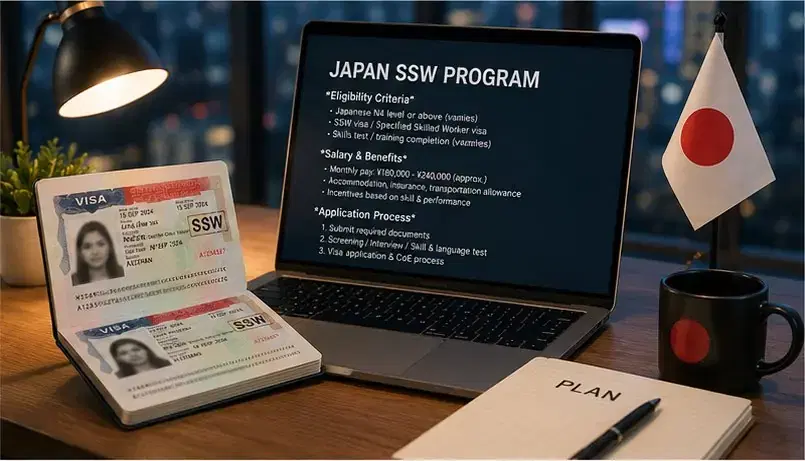
If you've heard people talk about "SSW" and felt a bit lost, don't worry. Let me explain it simply, and also show you how it's different from Japan's other visa options, since that's usually where the real confusion starts.
If you'd rather skip ahead and check your eligibility directly, you can head straight to NAVIS HR and talk to us. NAVIS HR
What Is the SSW Visa in Japan?
SSW stands for Specified Skilled Worker. In Japanese, it's called Tokutei Ginou. It's a Japan work visa for foreigners that started in 2019, because the country doesn't have enough workers in certain jobs.
With this visa, you don't need a degree. You just need to pass two tests, one for your skills, and one for basic Japanese language. This is why people often call it Japan's main visa route for unskilled and semi-skilled jobs, even though "unskilled" isn't quite fair, since you still need to pass a real skills test.
Why Does Japan Need Foreign Workers?
Japan has a lot of older people and fewer young workers. So there aren't enough people to work in places like hospitals, farms, factories, and construction sites. That's why Japan opened the SSW visa to foreign workers, gaikokujin roudousha, including people from India.
The government has set a five-year target for SSW workers, according to figures published by Japan's Immigration Services Agency. As of the end of December 2025, the agency reported a record 390,296 SSW visa holders in Japan, so there's still a lot of room for more applicants, including from India. Because this number changes every few months, always check the Immigration Services Agency's latest published statistics before relying on any figure, including this one.
From what I've seen working with candidates on this specific visa, the applicants who move fastest aren't always the most qualified on paper, they're the ones who start their Japanese language prep early and don't wait until they've "decided for sure" to begin studying.
What Jobs Can You Do on SSW?
SSW covers 19 types of jobs. Here are some of the main ones:
Each field has its own test. So the caregiver skills test for the Nursing Care field is different from the test for a driver or a farmer. Note that this SSW field is officially called Nursing Care, and covers nursing-care worker (caregiver) roles, not registered nurse positions, which follow a separate licensing path in Japan. If you're specifically looking at nursing-care jobs, we've covered that in full detail in our Nursing Jobs in Japan guide.
Just some of the 19 job fields covered under Japan's SSW visa
What Are the Two Types of SSW?
There are two levels: Type 1 and Type 2. Here's the simple difference:
| Type 1 | Type 2 | |
|---|---|---|
| How long can you stay? | Up to 5 years | No limit, can renew forever |
| Can your family join you? | No | Yes |
| How hard is the test? | Basic level | Advanced level |
| Permanent residency? | Not directly | May support a longer-term pathway, subject to Japan's separate PR requirements |
Most people start with Type 1. A few, in certain jobs, can move up to Type 2 later. One thing to know: nursing care jobs don't have a Type 2 option right now. Nurses who want to stay longer use a different visa for that.
How Does SSW Compare to Japan's Other Visas?
People often mix up SSW with Japan's Student Visa or the Engineer/Specialist in Humanities visa. Here's how they're actually different:
SSW vs Engineer/Specialist in Humanities Visa
The Engineer/Specialist in Humanities visa is for office jobs like IT, marketing, or translation. It usually needs a bachelor's degree, or 10 years of work experience if you don't have one. SSW doesn't need a degree at all, just a skills test. So if you don't have a degree, SSW is usually the easier route.
| SSW Visa | Engineer/Specialist in Humanities Visa | |
|---|---|---|
| Degree needed? | No | Usually yes, or 10 years of experience |
| Type of job | Manual and service jobs, like nursing, construction, driving | Office jobs, like IT, marketing, translation |
| Family allowed? | Only on Type 2 | Yes |
| Path to permanent stay | Through Type 2 | Usually after 10 years, faster for high scorers |
SSW vs Student Visa
A Student Visa is for studying at a school in Japan, not for full-time work. Students can work part-time, up to 28 hours a week, only with special permission. It doesn't lead to a real job visa on its own. SSW, on the other hand, is a full work visa from day one, with real pay and real working hours.
| SSW Visa | Student Visa | |
|---|---|---|
| Purpose | Full-time work | Studying, with limited part-time work |
| Work hours allowed | Full-time job | Up to 28 hours a week, with permission |
| Leads to long-term work? | Yes, directly | Not directly, you'd need to switch visa type later |
SSW vs ESD (Formerly TITP)
ESD, Employment for Skill Development, is the system Japan enacted into law on June 21, 2024 to eventually replace the old Technical Intern Training Program. It's set to take effect on April 1, 2027, confirmed on the Immigration Services Agency's official ESD program page. TITP still operates today, and the two systems are often confused, so it's worth knowing they serve different purposes and are on different timelines.
| SSW Visa | ESD (formerly TITP) | |
|---|---|---|
| Main purpose | Real employment, job-ready workers | Entry-level training that can lead into SSW |
| Skills level expected | Must already pass a skills test | Trains you toward that skills level |
| Typical next step | Renew, move to Type 2, or pursue PR | Usually transitions into SSW Type 1 |
You can check the current, official rules for both statuses directly on the Immigration Services Agency website, since program details are periodically updated by the Japanese government.
Who Is Eligible for the SSW Visa?
You can apply if you:
- Are 18 years or older
- Are in good health
- Pass the skills test for your job
- Pass a basic Japanese language test
- Have a clean police record
You don't need a college degree. That's what makes this visa easier to get than the Engineer/Specialist in Humanities visa, and more useful than a student visa if your goal is a real job in Japan.
What Salary Can You Expect on an SSW Visa?
Pay depends on the job, but most SSW workers earn between ¥180,000 and ¥280,000 per month. That's roughly ₹1,00,000 to ₹1,55,000 a month, though this changes with exchange rates. This is before extra pay for night shifts or overtime.
By law, you must be paid the same as a Japanese worker doing the same job. That's a real rule, not just a promise. What can be different between jobs is whether your housing is covered. Always ask about that before you accept an offer.
What Tests Do You Need to Pass?
You need to pass two tests:
- A skills test — shows you can actually do the job
- A Japanese language test — usually JLPT N4 or JFT-Basic, which means basic, everyday Japanese
You don't need to already speak Japanese to start preparing. Most people learn it through a training course before they take the test.
How Do You Apply? (Simple Steps)
Below is the simple path candidates take to go from picking their sector to flying to Japan.
- Pick a job — Pick the job sector you want
- Learn Japanese — Learn Japanese and prepare for your skills test
- Pass tests — Pass both tests (skills & language)
- Get matched — Get matched with a company in Japan
- Sign contract — Sign your job contract
- Visa Processing — Your employer applies for your visa paperwork
- Fly to Japan — You get your visa and fly to Japan
The simple SSW journey, from picking a job to flying to Japan
How Long Does It Take?
The visa paperwork itself usually takes 1 to 3 months once everything is ready. But getting ready, learning Japanese and passing your tests, usually takes several months to about a year, depending on how much Japanese you already know.
Can Indians Apply for SSW?
Yes. India and Japan made an official agreement in 2021 for this program. It's coordinated on India's side by NSDC International. So it's a real, government-approved path for Indians, not just something private agencies offer.
Key Points to Remember
- SSW is a real Japan work visa, no college degree needed
- It covers 19 job fields, each with its own skills test
- Type 1 lasts up to 5 years, no family. Type 2 has no limit, family allowed
- Pay is usually ¥180,000 to ¥280,000 a month (roughly ₹1,00,000 to ₹1,55,000)
- You need to pass a skills test and a basic Japanese test (JLPT N4 or JFT-Basic)
- SSW is better than a student visa if your real goal is full-time work
- India has had an official agreement with Japan for this program since 2021
Common Questions
Want to Know If You Qualify?
Talk to us for a simple, honest answer about your options.
Srinidhi V
SEO Lead at NAVIS HR, sharing accurate, up-to-date guidance on Japan's SSW visa pathway across sectors.
— Written from my desk at NAVIS HR